Corbeille
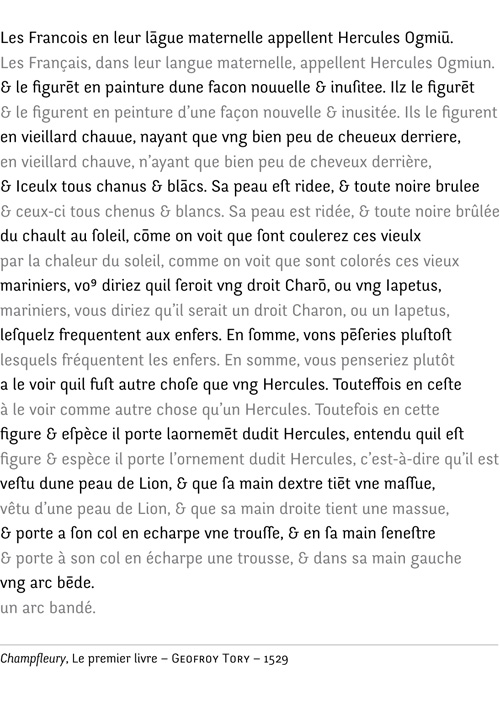
Tuesday, September 7th, 2010‡I was on board of a train rolling through the countryside and had the firm intention of giving a book back. As I knew the landscape quite well, I decided to give the mentioned book another look : it was a facsimile of Geoffroy Tory’s Champfleury, printed in 1529.
‡The book had been lent to me by the typophile colleague I was paying a visit to, typo-colleague who must have thought my typomania was a reason good enough for me to enjoy its content. The exact title, in french, is: Art et science de la vraie proportion des lettres, or in english: Art and science of the truthful proportion of letters. Even for someone accustomed to old prints, the typesetting and orthographic irregularity are quite demanding to read. And before the author goes on the subject of what makes perfect letters to his mind, he tries to demonstrate how the french language has all the attributes of a perfect expression of excellence, which must be quite natural, obviously.
‡This marvelous demonstration can be read with some irony as the french wielded by the author, for which he himself has great esteem, can look a bit anarchic to contemporary eyes.
‡To his defense, we can add that the Académie Française (an institution entitled to give, adapt and preserve the rules of french language), to which Richelieu has given the authority to resolve the problem of irregular typographic and orthographic writing, was founded only a century later. Confirming the role Richelieu had dreamt for this institution, it is not unusual to read in french books printed between 1600 and 1800 that french has to be the rightful heir of latin, as the French nation is supposedly descending directly from the Roman Empire. A very old fantasy that was a foundation to most of the wars France has been implicated in until the end of the nineteenth century.
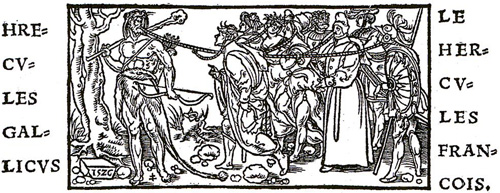
‡So proud are we, frenchmen, of our Republics, our Senates; another dwarf even reinstated the roman title of Tribune, shorly before inventing the Legion of Honor (a decoration still pined on proud citizen’s torso nowadays). All this has become quite common to us, thanks to a quite Frank education, but the way this book’s author demonstrates this relation between french and latin is even brighter than that. With the credit of some faith-worthy authors, he explains that the Romans, and even the Greeks, were nice people but they could only be similar to cheap wine when France has naturally the quality of a Saint-Émilion. And to give weight to this declaration, he refers to the myth of Hercules.
‡I’ll spare the details on why Hercules a deeply wise & reasoned man is, thus having to be french, and I’ll simply point the fact on which the demonstration is based, that is to say that Hercules, when named by latin & greek authors is always called Hercules Gallicus, and not Hercules Latinus nor Hercules Græcus. Anyone has to admit this is a proof that can’t be doubted…
‡Personnaly, I’m quite amused by such details, and I can bear to be the only one in this case. Such elements highlight some roots of a french mentality and pride that often exasperates me but that I mostly laugh about.
‡And to those that History lessons haven’t killed yet, I suggest a little compared reading to see what linguistic and typographic changes have happened throughout five hundred years.